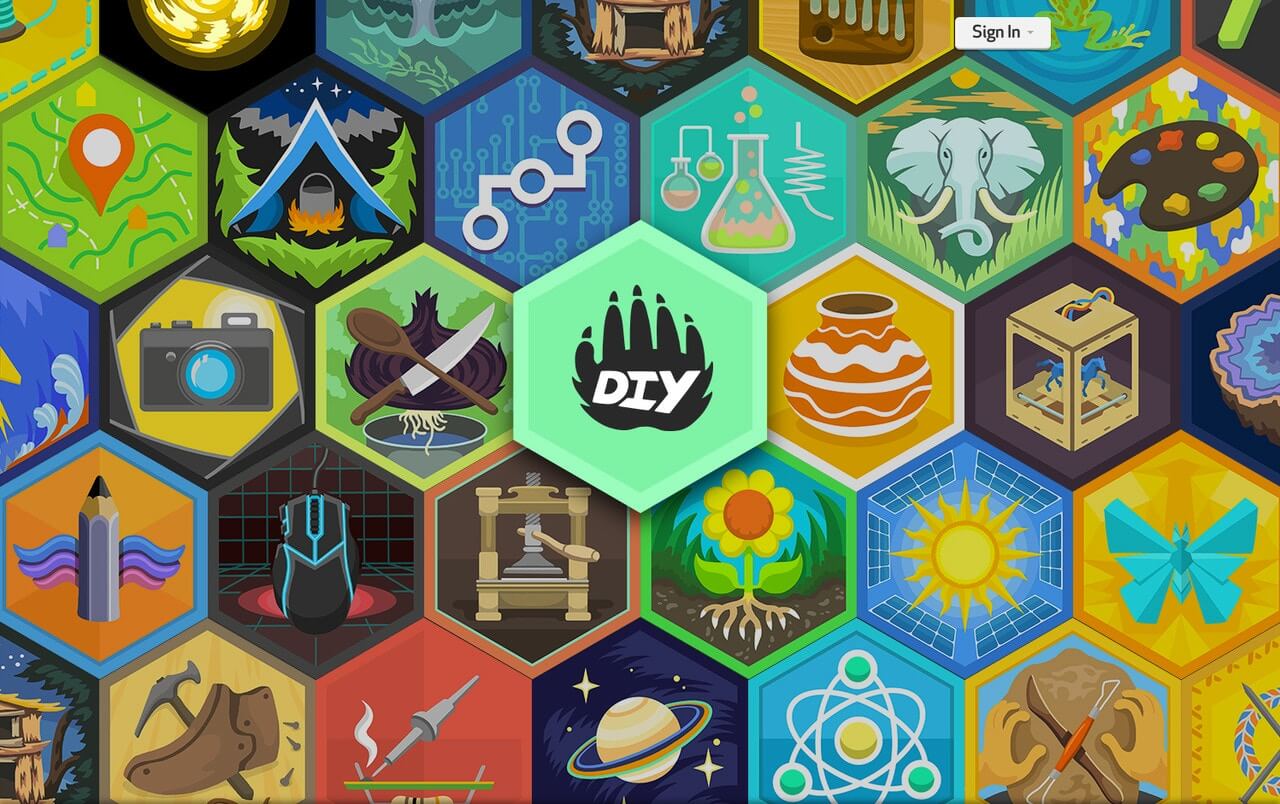
My daughter divides her free time into making comics, playing Minecraft, and building with LEGO. She’s obsessed with these activities. Adults may not always “get” childhood obsessions with Minecraft, duct tape, or LEGO, but what’s important is creating a space where all kids can learn, fail, experiment, and take risks through the passions they value. This idea inspired Vimeo founder Zach Klein to create DIY, an online community and app with over 400,000 young users where kids can nerd out and earn badges in skills like astronomy, beatmaking, game development, meme hacking, sailing, urban design, and even yeti research.
That’s right. Your kid can become a yeti expert. “My objective with this wide-ranging set of skills, and involving the community so closely in their development, is to give kids the chance to practice whatever makes them passionate now and feel encouraged — even if they’re obsessed with making stuff exclusively with duct tape,” Klein said in a recent EdSurge article titled How Minecraft and Duct Tape Wallets Prepare Our Kids for Jobs that Don’t Exist Yet. “It’s crucial that kids learn how to be passionate for the rest of their lives. To start, they must first learn what it feels like to be simultaneously challenged and confident. It’s my instinct that we should not try to introduce these experiences through skills we value as much,” he added. as look for opportunities to develop them, as well as creativity and literacy, in the skills they already love.
Parent Co. contacted Chalon Bridges, Director of Learning and Partnership, to learn more about DIY Camps. Bridges hires all DIY counselors and works with them to design dynamic curriculum and learning experiences. She also dedicates much of her time to forging alliances with school partners and youth Organizations like 4H are exploring how the app could be used with different communities of kids for learning opportunities. Y
ou can follow Chalon Bridges @chalonbridges and DIY @DIY on Twitter. Parent Co: A few of us at Parent Co. are using DIY Camps with our kids. We look for something a little different—something that’s not only a safe place for kids but also teaches skills they’ll need in the future. My seven-year-old daughter thrived at Lego Master Camp last month. She’s starting Film Director Camp this week! Chalon: That’s great! Oh, that’s so wonderful! Parent Co: Absolutely! We’re both excited that DIY doesn’t end after summer. Chalon: DIY Camps and diy.org operate year-round. We've had many schools that love the tools we created, and their teachers will use them to develop their own camps this fall. Parent Co: Can you tell us how DIY Camps work? Chalon: Essentially, it's about participatory learning—kids learning by doing. Every morning, a counselor posts a new video. There are three types: challenges, how-to, and pro tips. Challenges are creative prompts to try something new, often something they’ve never done before. We aim to create a safe space for experimentation. How-to videos teach basic techniques to help kids develop new skills. Pro tips cover more advanced techniques.
Over a month, a daily post from the counselor encourages kids to respond with their own videos. This starts a conversation where counselors can give mentorship and feedback, and kids can support each other. We hire top mentors from around the world who are passionate about their topics and pair them with kids interested in those topics. Kids walk away with new skills and hopefully, new friends. Parent Co: It’s an exciting time for education and online learning. I think DIY really opens a new door, showing what the future of learning could look like. Chalon: I spent the first twenty years of my career in formal education. Teachers are my heroes, and many try valiantly to innovate within the system. But change can be slow, and it will take time for all schools to prepare kids to be creative and innovative. I see a great opportunity in informal education to solve this now—to move quickly and make passion-driven learning accessible for kids immediately. It complements all the innovation happening in schools today. Parent Co: It’s fascinating to see my seven-year-old use video and social media tools for the first time. She gets excited when she receives comments from others, and she loves giving feedback.
What have you learned about kids’ interaction with video and social media through DIY? Chalon: When I first joined Zach, we analyzed comments and interactions in our community. What stood out was that we had a 99.8% kindness rating—amazing. That kind of positivity isn’t common in many online communities. I credit Zach for creating rules that foster such kindness. First, kids only share original work, which encourages respect and appreciation. Second, we have a "no jerk" policy—any unkind behavior results in warnings or suspension to keep the space safe for creativity. Parent Co:
What else makes DIY Camps different from other online learning platforms? Chalon: It's free-range learning without grades. It's fascinating to see what kids choose to do when learning is driven entirely by their interests. Our approach to technology is unique. Unlike most apps that keep kids glued to screens, we send them back into the real world, where most learning happens as they respond to challenges. They share their results on our app, creating a meaningful interaction between technology and real-world activity. Plus, we're ad-free, providing a safe environment without exposure to ads. Parent Co: What’s next for DIY Camps? Chalon: We aim to have hundreds of camps within the next year. We’re a small company—just twelve of us now. Since launching, I've hired nineteen counselors, and we plan to grow to about sixty by next year. We want our camps to cover a wide range of topics and interests. What you see today is just the beginning—far from the final vision. Parent Co: That’s incredible! Chalon: We also love that many international kids participate. In an early private beta, we had kids from Australia, Ireland, Chicago, and more. It creates a fantastic learning environment and global connection. About 25% of our participants are international, with room to grow. others around the world. We’re thrilled with what we see at DIY and can’t wait to see what the future holds!
